Introduction
Cooling towers are critical infrastructure...
Introduction: Why FRP Grating for Cooling Towers
Cooling towers are essential components in industrial process cooling, HVAC systems, and power generation facilities worldwide. These structures operate in constantly wet, chemically treated, and thermally cycling environments that pose severe challenges to conventional building materials. FRP cooling tower components — particularly fiberglass reinforced plastic grating — have emerged as the preferred solution for decking, walkways, and structural platforms in these demanding settings.
This comprehensive guide explores the applications, benefits, material specifications, installation practices, and maintenance requirements of fiberglass grating in cooling towers. Whether you are specifying materials for a new installation, planning a retrofit of existing metal components, or simply evaluating the performance of frp cooling tower grating panels for improved longevity, this article provides the technical depth you need to make an informed decision.
We will answer the most frequently asked questions about FRP in cooling towers, including how to select the right material grade, how composites compare to metal alternatives, what causes material degradation, and how to maintain and clean glass-reinforced plastic parts effectively. By the end, you will understand why fiberglass grating has become the go-to material for cooling tower applications across chemical plants, refineries, power stations, and commercial HVAC systems.
What Is FRP Grating for Cooling Towers?
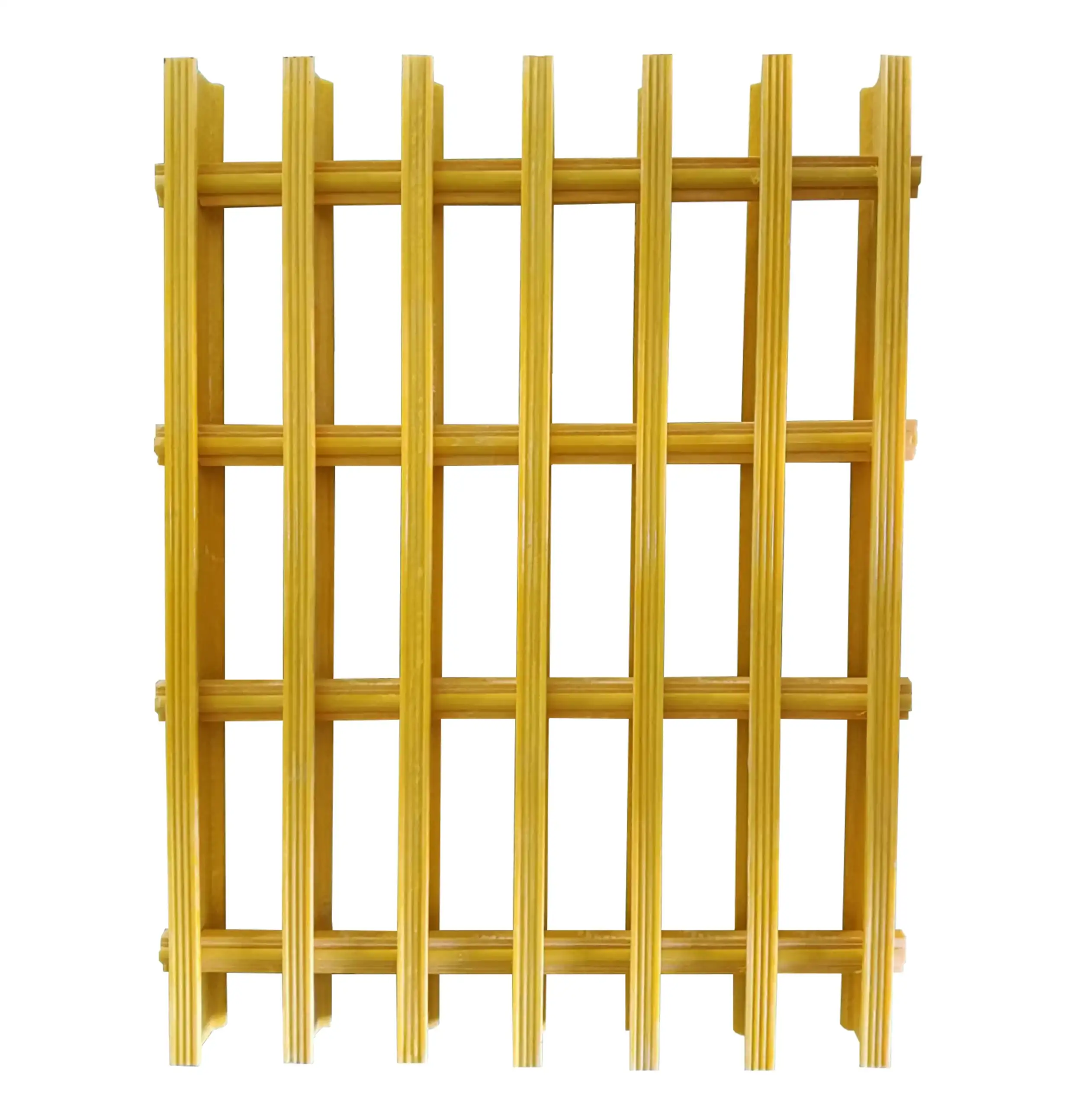
FRP (Fiberglass Reinforced Plastic) grating is a composite material made from continuous glass fiber strands embedded in a thermosetting resin matrix. When applied to cooling tower environments, the material is specifically engineered to withstand continuous water exposure, chemical treatment agents, temperature fluctuations, and UV radiation.
Cooling tower grating systems typically consist of pultruded or molded FRP panels manufactured with corrosion-resistant resin formulations. Unlike standard industrial grating, frp cooling tower grating panels are designed with specific resin-to-glass ratios and surface treatments that optimize performance in wet, chemically aggressive environments.
How FRP Grating Differs from Standard Industrial Grating
While all FRP grating shares the same basic composition of glass fibers and resin, cooling tower-grade panels incorporate several key enhancements:
- Corrosion-resistant resin systems: Isophthalic polyester, vinyl ester, or epoxy novolac resins that resist chlorine, biocides, scale inhibitors, and pH extremes
- UV-stabilized surface veil: A protective layer that prevents fiber bloom and surface degradation from prolonged sun exposure
- Enhanced fire resistance: Flame-retardant additives that meet ASTM E84 Class 1 or IMO FTP Code requirements for industrial safety
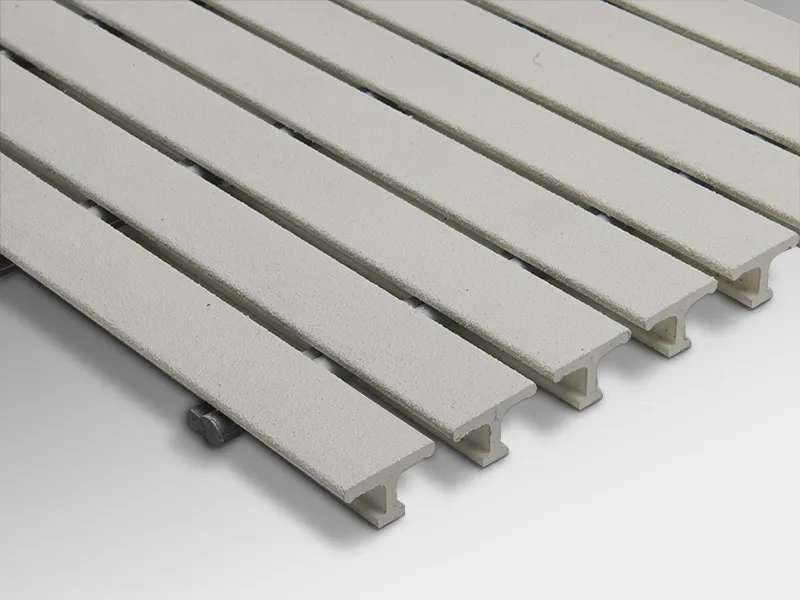
- Anti-slip surface: Grit-coated or concave-convex surface patterns that maintain slip resistance even when continuously wet
These specifications ensure that frp grating for cooling tower deck installations deliver reliable service life of 20 years or more, even under the constant thermal and chemical stress typical of cooling tower operation.
Key Applications of FRP Grating in Cooling Towers
FRP grating serves multiple critical functions within cooling tower structures. Understanding these applications helps engineers and facility managers identify where fiberglass components deliver the greatest return on investment. The main applications of FRP in cooling towers include structural decking, access walkways, fan deck platforms, and distribution basin covers.
Cooling Tower Decks and Platforms: The primary application of frp grating for cooling tower deck areas is in the structural flooring that supports maintenance personnel and equipment. Cooling tower decks must bear heavy loads while remaining lightweight enough to minimize structural demands on the tower framework. FRP grating panels provide an excellent strength-to-weight ratio, typically weighing 60-70% less than equivalent steel panels while delivering comparable load-bearing capacity.
Walkways and Access Paths: Frp cooling tower walkway grating is installed along perimeter access routes, between cell divisions, and leading to inspection points. These walkways require consistent slip resistance even when saturated with water and biofilm. The inherent corrosion resistance of FRP eliminates the rust staining that plagues steel walkways, keeping the cooling tower water free from iron contamination that could accelerate biological fouling.
Fan Deck Areas: The fan deck — the top platform where fans and drives are mounted — experiences constant vibration, exposure to warm moist air plumes, and heavy maintenance traffic. FRP grating in these areas resists the fatigue loading from fan vibration and eliminates the corrosion failure risk that could lead to catastrophic fan deck collapse. Many installations also use composite grating panels for distribution basin covers, splash deck surfaces, and inlet screen supports.
Water Distribution and Fill Support: Beyond personnel access, FRP grating is increasingly used as structural support for cooling tower fill media and drift eliminators. The lightweight nature of fiberglass reduces the load on tower support beams while the corrosion resistance ensures decades of trouble-free service in the saturated fill zone.
FRP vs Metal: Choosing the Right Cooling Tower Fill Material
One of the most common decisions in cooling tower material selection is choosing between FRP and metal components. Each material has distinct advantages, but for cooling tower environments, FRP consistently outperforms metal in several critical areas.
| Property | FRP Grating | Galvanized Steel | Stainless Steel 304 |
|---|---|---|---|
| Corrosion resistance | Excellent — immune to galvanic and chemical corrosion | Moderate — zinc coating degrades over time in treated water | Good — but susceptible to chloride stress corrosion cracking |
| Weight (kg/m²) | 14–28 (60-70% lighter than steel) | 45–85 | 45–85 |
| Service life in cooling tower | 20–30 years | 5–12 years (coating dependent) | 10–20 years (chloride dependent) |
| Slip resistance when wet | Excellent (integral grit surface) | Poor (smooth when wet) | Moderate (smooth surface) |
| Thermal conductivity | Low (safer for personnel) | High (hot surfaces in summer) | High (hot surfaces in summer) |
| Initial cost | Moderate | Low | High |
| Lifecycle cost (20 years) | Low — minimal maintenance | High — frequent replacement | Moderate-High |
FRP vs Metal Cooling Tower Fill: When comparing FRP and metal as cooling tower fill media, the key difference lies in chemical resistance and biofouling behavior. Metal fill, particularly galvanized steel, can leach zinc ions into the cooling water, accelerating biological growth and increasing treatment chemical demand. FRP fill media remains chemically inert, providing consistent thermal performance without introducing contaminants. Additionally, FRP does not suffer from the pitting corrosion or galvanic corrosion that frequently causes premature failure of metal components in cooling towers with treated recirculating water.
The cost of FRP packing for cooling towers varies by resin grade, panel thickness, and fabrication complexity, but the total lifecycle cost typically favors FRP when factoring in replacement intervals and maintenance labor. While initial FRP material costs may be 20-40% higher than galvanized steel, the extended service life and near-zero maintenance requirements deliver a lower total cost of ownership over a 20-year operating horizon.
Cooling Tower Fiberglass Grating Specification and Selection
Selecting the right cooling tower fiberglass grating specification is critical to achieving optimal performance and service life. This section covers the key material grades, design parameters, and cost factors that should guide your specification process.
Material Grades and Resin Systems
The resin matrix is the single most important factor determining FRP grating performance in cooling towers. Four primary resin systems are commonly specified:
- Isophthalic Polyester: The standard grade for general cooling tower service. Offers good resistance to dilute acids, alkalis, and cooling water treatment chemicals. Suitable for temperatures up to 100°C (212°F). Cost-effective for most cooling tower deck and walkway applications.
- Vinyl Ester: Recommended for cooling towers with aggressive chemical treatment programs, high chlorine levels, or elevated temperatures up to 130°C (266°F). Provides superior resistance to chemical attack and thermal cycling. The preferred resin for FRP grating panels in chemical processing plant cooling towers.
- Epoxy Novolac: The highest chemical resistance grade, specified for extreme conditions with strong oxidizing biocides, organic solvents, or temperatures exceeding 130°C. Used primarily in specialized industrial cooling tower applications.
- Fire-Retardant Formulations: All cooling tower resin systems should include flame-retardant additives to meet building code requirements. Verify that the specified grating meets ASTM E84 Class 1 (Flame Spread Index ≤25) or local fire safety standards.
Load Requirements and Cost Considerations
The mechanical design of FRP grating in cooling tower service must account for the specific loads and support conditions at each installation point. Key specification parameters include:
- Deflection limits: Typical cooling tower specifications require deflection of L/200 or less under design load. Standard panel thicknesses of 25 mm (1 inch) to 50 mm (2 inches) accommodate most pedestrian and light maintenance traffic loads.
- Concentrated load capacity: Fan deck areas and equipment access platforms may require grating rated for concentrated loads of 500 kg or more, achieved through thicker panels or closer support spacing.
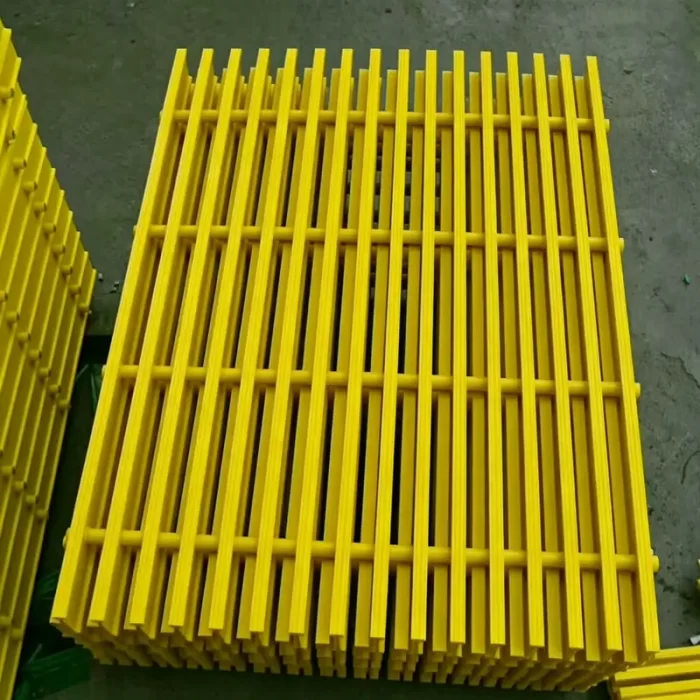
- Panel size and configuration: Standard pultruded grating panels are available in 1.22m × 3.66m (4ft × 12ft) sizes with custom cut-outs for piping, columns, and equipment penetrations.
How much does FRP packing for cooling towers cost? As a general guideline, standard isophthalic polyester grating for cooling tower deck applications ranges from $35-$55 per square meter. Vinyl ester and fire-retardant grades range from $55-$85 per square meter. These costs should be evaluated against the 20-30 year service life and minimal maintenance requirements to calculate true lifecycle economics.
Installation Guide for FRP Grating in Cooling Towers
Proper installation of FRP grating in cooling towers is essential to achieving the expected service life and performance. Unlike metal grating installation, FRP requires specific attention to thermal expansion, bearing support, and fastener selection to prevent stress concentrations and premature failure.
Preparation and Handling
Before installation, FRP grating panels should be acclimated to the site environment for at least 24 hours. Panels should be stored flat on a level surface, protected from direct sunlight and contamination. How to install FRP packing in a cooling tower? The process follows these key steps:
- Structural inspection: Verify that support steel or concrete beams are level, within tolerance (±3mm over 3m span), and free from sharp edges that could damage FRP surfaces at contact points.
- Cutting and modification: Use carbide-tipped blades for cutting FRP panels to size. Diamond saws or abrasive cut-off wheels also work well. Always cut with the finished surface facing up to minimize edge splintering. Cut edges should be sealed with matching resin to prevent moisture wicking along exposed fibers.
- Hole drilling: For bolt-through installations, drill holes 2-3mm larger than the fastener diameter to accommodate thermal expansion. Use carbide-tipped drill bits and back the panel with a wooden block to prevent exit-side splintering.
Fastening and Support
FRP grating in cooling towers should be fastened using corrosion-resistant hardware. Stainless steel 316 or titanium fasteners are recommended for long-term service in chemically treated cooling tower environments. For frp cooling tower walkway grating installations, continuous clamping bars along the full panel width distribute clamping forces evenly and prevent localized crushing of the composite material. Critical installation guidelines include:
- Minimum bearing support of 25mm (1 inch) on each side of the panel
- Expansion gaps of 3-6mm between adjacent panels to accommodate thermal movement
- Hold-down clips every 600-900mm along supported edges for pedestrian traffic areas
- Through-bolting with large-diameter washers (minimum 25mm) in high-vibration areas such as fan decks
- Never over-torque fasteners — FRP compresses under clamping force; use a maximum torque of 10-15 Nm for M10 bolts
Post-Installation Inspection
After installation, verify that all panels are securely fastened, expansion gaps are uniform, and cut edges are properly sealed. Conduct a full load test on accessible sections before declaring the installation complete. Document the installation date, material specifications, and fastener types used for future maintenance reference.
Maintenance and Cleaning of FRP Cooling Tower Parts
Although FRP grating requires significantly less maintenance than metal alternatives, proper care is essential to maximize service life in cooling tower environments. How to maintain and clean FRP parts in cooling towers? A structured maintenance program should address the following areas:
Routine Cleaning Procedures
The moist, nutrient-rich environment of cooling towers promotes biological growth on all surfaces, including FRP grating. Biofilm accumulation can reduce slip resistance and, over time, create conditions that promote material degradation. Recommended cleaning practices include:
- Weekly rinsing: High-pressure water washing (2000-3000 psi) removes loose biofilm and debris. Avoid directing the spray at cut edges or damaged areas where water could penetrate the laminate.
- Monthly chemical cleaning: For persistent biological growth, apply a mild bleach solution (1:10 dilution of household bleach in water) or a commercial cooling tower biocide compatible with FRP. Allow 15-20 minutes of contact time, then rinse thoroughly with fresh water.
- Quarterly deep cleaning: Remove heavy scale deposits using a diluted acidic cleaner (phosphoric or citric acid based). Never use hydrochloric acid (muriatic acid) on FRP as it can attack the resin matrix. Test any cleaning chemical on a small inconspicuous area first.
Inspection Checklist
During each cleaning cycle, visually inspect the grating for signs of damage or degradation:
- Check for surface cracking, crazing, or fiber bloom (exposed glass fibers)
- Examine cut edges for delamination or moisture penetration
- Verify fastener tightness — FRP grating panels can loosen over time due to thermal cycling
- Inspect contact points between FRP and metal supports for galvanic activity or wear
- Test slip resistance in wet conditions — resurface with anti-slip coating if needed
Following these maintenance practices for FRP grating in cooling towers ensures the components continue to perform safely and effectively throughout their intended service life, with minimal intervention compared to the frequent painting, corrosion repair, and replacement required by metal grating.
Preventing FRP Degradation in Cooling Towers
Although FRP is inherently corrosion-resistant, long-term exposure to cooling tower conditions can cause degradation if the material is not properly specified, installed, or maintained. Understanding the mechanisms of FRP degradation is essential for preventing premature failure.
What causes FRP degradation in cooling towers and how to prevent it? The primary degradation mechanisms in cooling tower environments include:
Chemical Attack on the Resin Matrix
The resin matrix is the weakest link in FRP's chemical resistance chain. If the resin formulation is not matched to the specific cooling tower water chemistry, chemical attack can soften, swell, or dissolve the resin, exposing the glass fibers. Prevention strategies include:
- Selecting the correct resin grade (vinyl ester for aggressive chemical environments, epoxy novolac for extreme conditions)
- Installing a chemical-resistant surface veil (C-glass or Nexus veil) that provides an additional barrier
- Conducting a thorough water chemistry analysis before specifying materials — pH, chlorine levels, biocide types, and temperature all affect resin compatibility
- Ensuring all cut edges are sealed with compatible resin to prevent capillary wicking
Thermal Cycling Fatigue
Cooling towers experience daily temperature swings from ambient conditions and operational cycling. The differential thermal expansion between FRP and metal support structures can create stresses at connection points. Over years of cycling, this can lead to:
- Loosening of mechanical fasteners
- Localized crushing at bearing points where FRP expands against rigid supports
- Micro-cracking in the resin matrix at stress concentration points
Prevention: Use oversized bolt holes (2-3mm clearance), elastomeric bearing pads between FRP and steel, and periodic re-torquing of fasteners during routine maintenance.
UV Degradation
Cooling tower fan decks and external walkways receive direct sunlight during daylight hours. UV radiation can break down the resin surface, causing fading, chalking, and eventually fiber bloom (exposed glass fibers). Prevention measures include:
- Specifying UV-stabilized resin formulations with light stabilizers and UV absorbers
- Using gel coat or painted surface finishes on UV-exposed surfaces
- Applying a UV-protective coating during routine maintenance if the original surface shows signs of degradation
Galvanic Activity at Dissimilar Material Junctions
While FRP itself does not corrode, it can create galvanic cells when in contact with metals in the presence of cooling tower water. Carbon fiber reinforced composites are especially problematic in this regard. Prevention: Ensure no carbon fiber is used in cooling tower FRP grating, and electrically isolate FRP from metal supports using non-conductive bearing pads or gaskets.
By addressing these degradation mechanisms during the specification and maintenance phases, FRP grating components for cooling tower applications can reliably achieve their full 20-30 year design life without significant performance loss.
Conclusion and Final Recommendations
FRP grating has established itself as the material of choice for cooling tower decking, walkway, and platform applications across a wide range of industrial sectors. The combination of corrosion resistance, lightweight construction, anti-slip properties, and long service life delivers compelling advantages over traditional metal alternatives.
Key Takeaways
- Superior corrosion resistance: FRP grating eliminates the rust and chemical attack that plagues galvanized and stainless steel in cooling tower environments, delivering 20-30 years of service life with minimal maintenance.
- Application versatility: From main access decks to fan platforms, distribution basin covers, and fill support structures, composite grating panels can be tailored to virtually any cooling tower component requiring structural flooring.
- Specification matters: The choice of resin system — isophthalic polyester, vinyl ester, or epoxy novolac — should be driven by the specific water chemistry and temperature conditions at your facility. Never underspecify the resin grade to save initial costs.
- Cost-effective lifecycle: Despite higher initial material costs compared to basic galvanized steel, FRP delivers significantly lower total ownership costs over a 20-year horizon when replacement intervals, maintenance labor, and downtime are factored into the calculation.
- Proper installation is critical: Bearing support, thermal expansion accommodation, and corrosion-resistant fasteners are non-negotiable for long-term FRP grating performance in cooling towers.
When selecting frp grating for cooling tower deck or walkway systems, work with experienced FRP fabricators who understand cooling tower service conditions. Request material certifications including resin type, glass content, fire rating, and load test data. A properly specified and installed FRP grating system will provide safe, reliable access for decades with minimal maintenance intervention.
For specific project requirements or assistance with material selection, consult our technical team who can help match the right cooling tower fiberglass grating specification to your operating conditions and budget parameters.