Introduction
When sourcing fiberglass reinforced plastic (FRP) grating for industrial projects, one of the most critical decisions buyers face is choosing between pultruded vs molded grating...
Introduction
When sourcing fiberglass reinforced plastic (FRP) grating for industrial projects, one of the most critical decisions buyers face is choosing between pultruded vs molded grating. While both products are manufactured from fiberglass and resin, they differ significantly in manufacturing process, structural performance, weight, cost, and application suitability. Understanding the main difference between pultruded and molded fiberglass grating is essential for making a cost-effective and technically sound purchasing decision.
This comprehensive comparison guide examines the difference between pultruded and molded fiberglass grating across every relevant dimension — from production methods and mechanical properties to pricing and installation. Whether you are a procurement manager evaluating suppliers, an engineer specifying materials, or a facility owner planning a retrofit, this guide will help you determine which type of FRP grating best fits your requirements.
We will cover the manufacturing processes that define each product, compare their strength and load-bearing capabilities, analyze weight differences, explore ideal application scenarios, and provide a clear cost-benefit analysis. You will learn which is stronger: pultruded or molded FRP grating, when to choose pultruded grating over molded grating, and whether pultruded or molded grating is more cost-effective for industrial projects. By the end, you will have a complete understanding of the difference between molded grating and pultruded grating and be equipped to make an informed selection.
What Is Pultruded Fiberglass Grating?
Manufacturing Process of Pultruded Grating
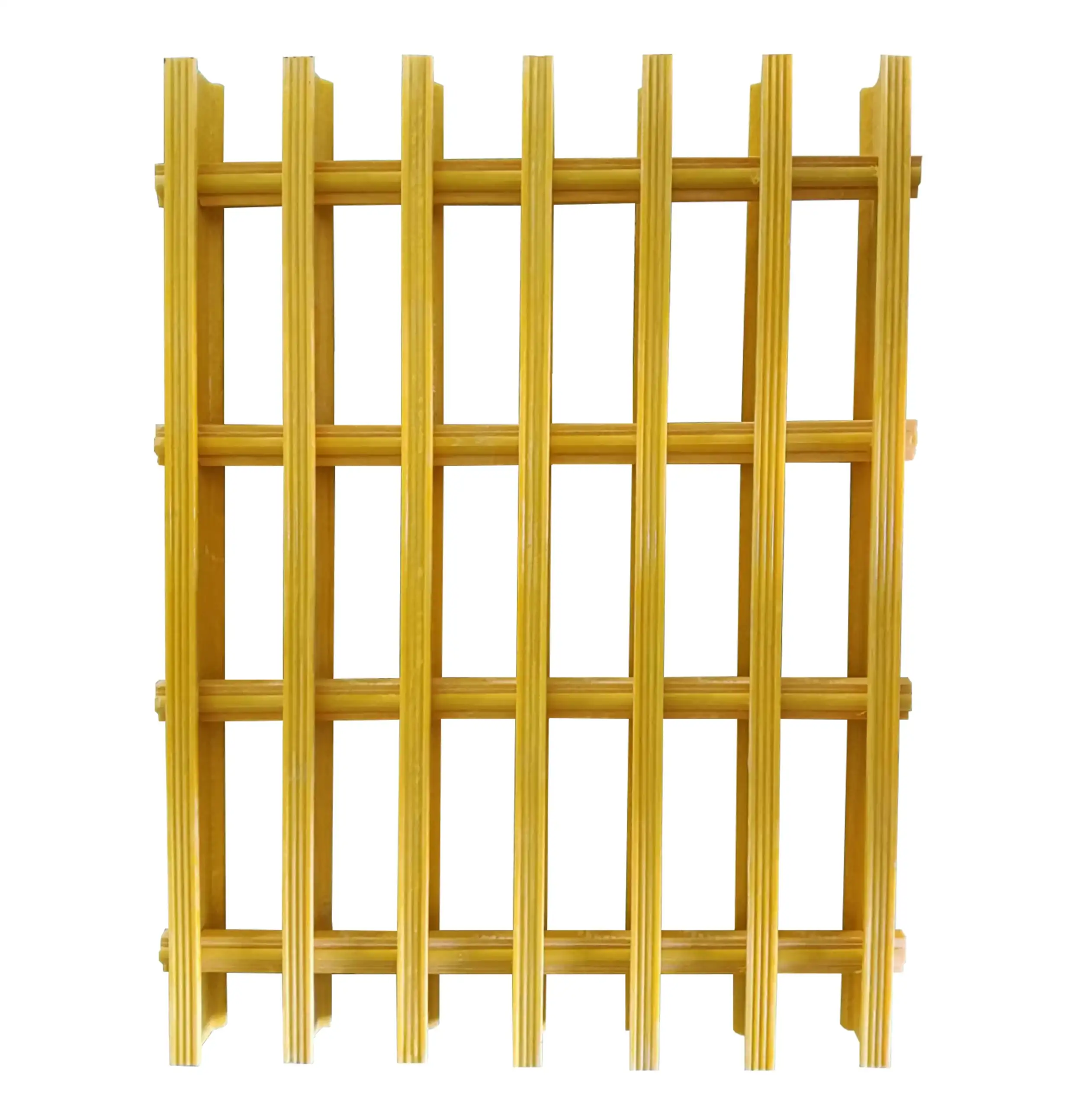
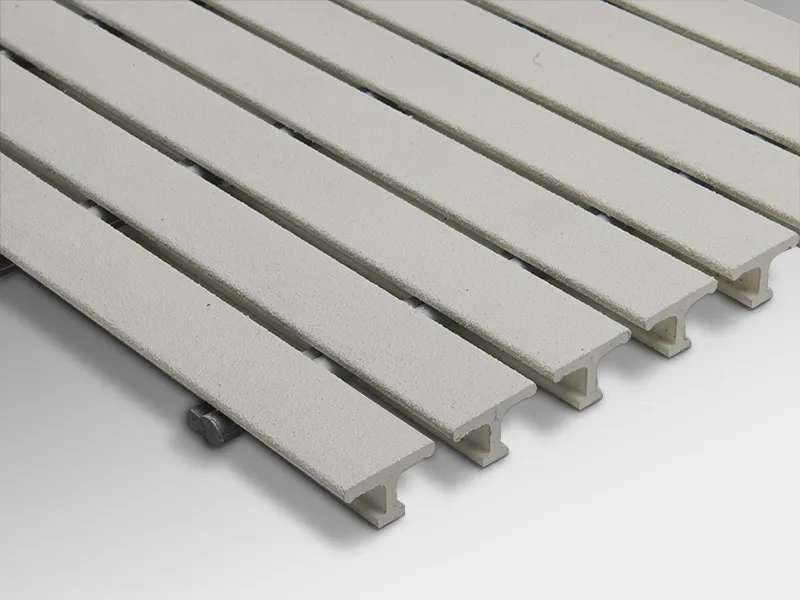
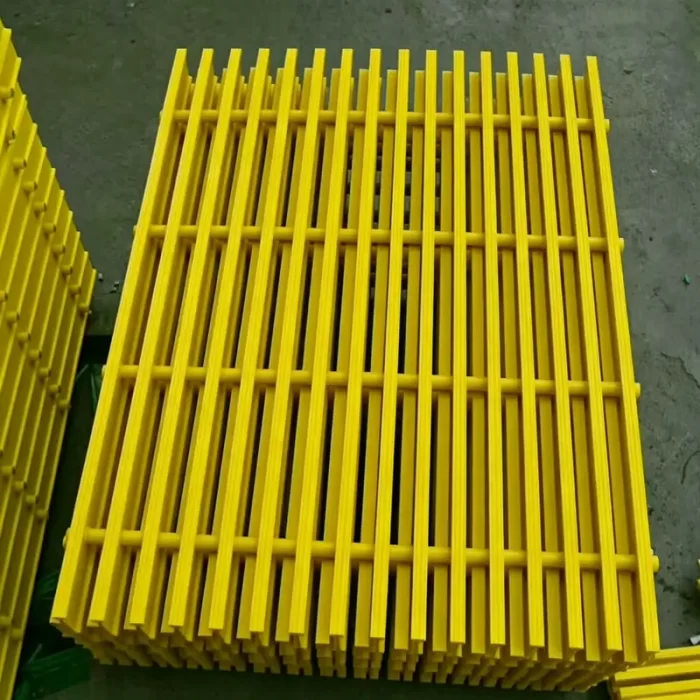
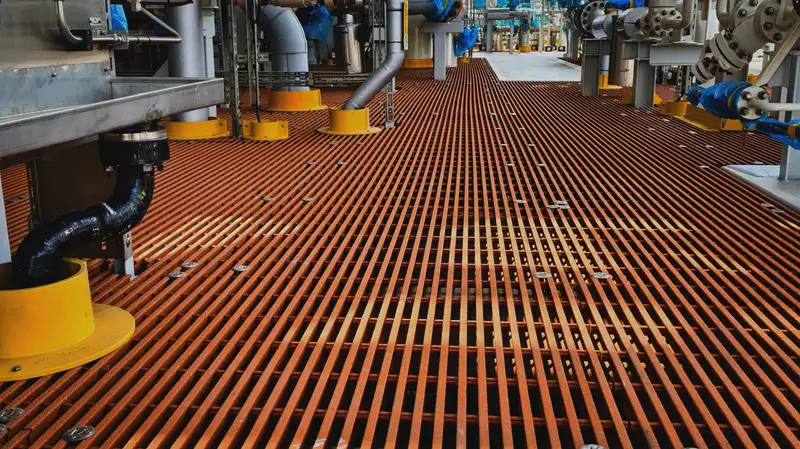
Pultruded fiberglass grating is manufactured through a continuous pultrusion process. Continuous fiberglass rovings and mats are pulled through a resin bath containing thermosetting polyester or vinyl ester resin, then drawn through a heated steel die that shapes and cures the material into solid profiles. These pultruded profiles — typically I-beams, T-bars, or flat bars — are then assembled into grating panels by mechanically locking them together with cross rods or through a secondary assembly process.
The pultrusion process produces grating with continuous glass fiber reinforcement running the full length of each bearing bar. This unidirectional fiber orientation gives pultruded grating exceptional strength in the load-bearing direction. The process also allows for precise dimensional control, consistent wall thickness, and the ability to create customized lengths without waste.
Key Characteristics of Pultruded Grating
- High strength-to-weight ratio: Pultruded grating offers superior longitudinal strength, making it ideal for applications requiring long unsupported spans.
- Excellent corrosion resistance: The resin system fully encapsulates the glass fibers, providing outstanding protection against chemicals, moisture, and UV exposure.
- Fire retardant options: Available with flame-retardant resin formulations that meet ASTM E84 Class 1 or BS 476 standards.
- Non-conductive and non-magnetic: Ideal for electrical substations, telecommunications facilities, and MRI rooms.
- Low maintenance: Does not rust, rot, or corrode — requires no painting or protective coatings.
- Customizable: Bearing bar depths from 1 to 3 inches, spacing options from 1.5 to 3 inches, and various surface finishes including grit-top and concave profiles.
Pultruded grating is typically available in standard panel sizes of 8 ft × 4 ft, 10 ft × 4 ft, and 20 ft × 4 ft, with custom lengths available from most manufacturers. The most common resin systems used are isophthalic polyester, vinyl ester, and phenolic for high-temperature or fire-critical applications.
What Is Molded Fiberglass Grating?
Manufacturing Process of Molded Grating
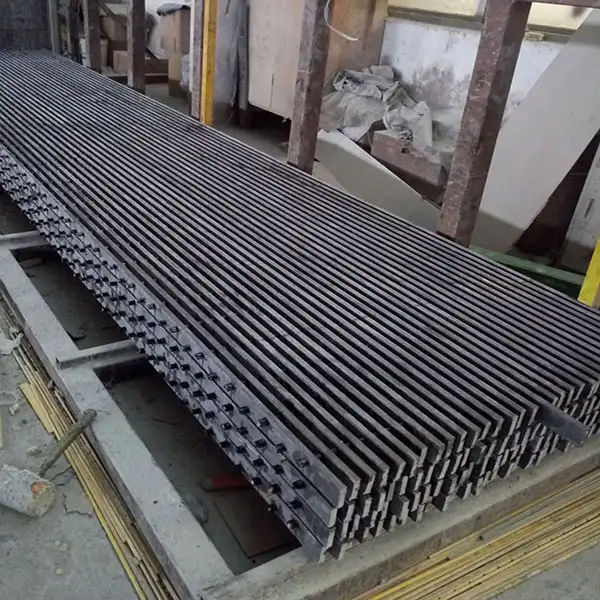
Molded fiberglass grating, also known as compression-molded or open-molded grating, is produced through a matched-die molding process. Layers of continuous strand glass fiber mat and chopped strand mat are placed into a steel mold along with liquid thermosetting resin. The mold is closed under hydraulic pressure and heat, curing the resin into a single, monolithic grating panel with an integral anti-slip surface pattern. This process creates a one-piece structure with no joints, welds, or mechanical fasteners.
Unlike the linear pultrusion process, molding produces grating with randomly oriented glass fibers distributed evenly throughout the panel. This isotropic fiber arrangement gives molded grating balanced mechanical properties in both directions — though its overall strength per unit thickness is generally lower than pultruded grating's longitudinal strength. The molding process also produces a thicker, heavier panel compared to pultruded grating of equivalent bearing bar depth.
Key Characteristics of Molded Grating
- Inherent anti-skid surface: The molded diamond or grit pattern is formed directly into the panel, providing excellent slip resistance without additional coatings.
- Consistent bidirectional strength: Random fiber orientation provides similar load capacity in both directions, useful for applications where loads come from multiple angles.
- Corrosion resistant throughout: The monolithic structure has no exposed cut edges or mechanical joints that could wick moisture or chemicals into the material.
- Cost-effective for standard sizes: Molds produce repeatable panels at high volume, making molded grating very competitive for standard configurations.
- Self-colored options: Resin can be pigmented in standard safety colors (yellow, orange, gray, green) without requiring painting.
- Good electrical insulation: Like pultruded grating, molded FRP grating is naturally non-conductive.
Molded grating is typically produced in standard panel sizes such as 4 ft x 8 ft and 4 ft x 12 ft, with thicknesses ranging from 1 inch to 2 inches. Common resin systems include polyester, vinyl ester, and specialty formulations for enhanced chemical resistance or fire performance. The molded grating manufacturing process is particularly well-suited to producing large volumes of identical panels at economical per-unit costs.
Pultruded vs Molded Grating: Key Differences
Understanding the difference between molded grating and pultruded grating requires examining several performance dimensions side by side. While both products are made from fiberglass and resin, their distinct manufacturing processes create significant differences in structural behavior, weight, cost, and application suitability. The table below summarizes the key comparison points.
| Comparison Factor | Pultruded Grating | Molded Grating |
|---|---|---|
| Manufacturing Process | Continuous pultrusion — fibers pulled through resin bath and heated die | Compression molding — fiber mats pressed in heated mold |
| Fiber Orientation | Unidirectional (continuous fibers along bearing bar length) | Random (chopped and continuous strand mat, isotropic) |
| Structural Form | Assembled from individual bearing bars + cross rods | Single monolithic panel, no joints or fasteners |
| Longitudinal Strength | Very high — ideal for long spans and heavy loads | Moderate — balanced but lower than pultruded |
| Transverse Strength | Lower — cross rods provide lateral stability only | Moderate — similar to longitudinal due to random fiber orientation |
| Weight per Square Foot | Lighter — typically 3-6 lbs/sqft for 1-inch depth | Heavier — typically 5-9 lbs/sqft for 1-inch depth |
| Panel Sizes | Customizable lengths up to 24+ ft | Limited by mold size (typically 4 x 8 ft or 4 x 12 ft) |
| Surface Pattern | Smooth with optional grit top; concave surfaces available | Integrated diamond/grid pattern; inherently slip-resistant |
| Cost per Square Foot | Higher for standard sizes; more economical for custom spans | Lower for standard sizes; mold-dependent pricing |
| Installation | Requires mechanical assembly or custom fabrication | Simple drop-in installation; easy field cutting |
Manufacturing Comparison
The fundamental difference between pultruded and molded fiberglass grating begins with the production method. Pultrusion is a continuous, automated process that creates high-strength linear profiles with consistent cross-sections. The glass fibers run continuously along the length of each bearing bar, providing exceptional strength in one direction. In contrast, molding uses a batch process where randomly oriented glass fiber mats are compressed with resin under heat and pressure. This creates a panel with uniform properties in both directions but lower peak strength values.
Strength and Load Capacity Comparison
The question "Which is stronger: pultruded or molded FRP grating?" is one of the most common inquiries from buyers. The answer depends on the loading direction. Pultruded grating has significantly higher strength in the longitudinal (bearing bar) direction. A standard 1.5-inch pultruded grating can support concentrated loads of 4,000+ lbs with deflection under 0.25 inches on a 2-ft span. The same thickness molded grating typically supports 2,000-3,000 lbs under identical conditions. However, molded grating offers more balanced bidirectional strength — if loads come from multiple angles, its isotropic structure may perform better overall. For long-span applications (over 3 ft unsupported), pultruded grating is almost always the stronger choice.
Weight Differences
The weight differences between pultruded and molded fiberglass grating are directly related to their respective manufacturing processes. Pultruded grating uses continuous fibers in a high glass-to-resin ratio (typically 65-75% glass by weight), resulting in a lighter but stronger product. Molded grating uses a mix of continuous strand mat and chopped strand mat with a lower glass content (typically 30-50% glass by weight), making it denser and heavier. For a 1-inch thick panel, pultruded grating weighs approximately 3-5 lbs/sqft, while molded grating of equivalent thickness weighs 5-8 lbs/sqft. This 40-60% weight difference can significantly impact shipping costs, structural support requirements, and installation labor.
Application Comparison: When to Choose Which
Knowing when to choose pultruded grating over molded grating is essential for optimizing project performance and budget. Each type excels in specific environments, and selecting the wrong product can lead to premature failure, unnecessary expense, or safety hazards. Below we break down the ideal applications for each type.
Best Applications for Pultruded Grating
Pultruded grating is the preferred choice when:
- Long spans are required: Pultruded grating can span up to 8-10 ft without intermediate supports, making it ideal for walkways, platforms, and trench covers where support structures are widely spaced.
- High load capacity is critical: For heavy-duty industrial flooring, vehicle access ways, and equipment platforms where concentrated loads exceed 1,000 lbs per square foot.
- Custom lengths reduce waste: When a project requires grating in non-standard lengths, pultruded grating can be manufactured to exact dimensions, eliminating costly field cuts and material waste.
- Structural integrity under continuous use: Applications such as offshore platform walkways, chemical plant mezzanines, and water treatment plant catwalks benefit from pultruded grating's superior load-bearing characteristics.
- Fire-rated environments: Pultruded grating with phenolic or specialized fire-retardant resin systems meets stringent fire codes for oil and gas facilities, refineries, and public infrastructure.
Best Applications for Molded Grating
Molded grating offers distinct advantages in these scenarios:
- Anti-slip flooring without add-ons: The integrated diamond pattern provides inherent slip resistance, making molded grating ideal for wet environments like shower floors, pool decks, and food processing areas.
- Chemical containment areas: The monolithic one-piece construction has no crevices or joints where corrosive chemicals can accumulate, making it excellent for chemical storage dikes, battery rooms, and acid handling areas.
- Standard panel installations: When the project layout matches standard mold sizes (4 x 8 ft or 4 x 12 ft), molded grating offers the most cost-effective solution.
- Light to moderate loading: For pedestrian walkways, mezzanine flooring in light industrial settings, and access platforms with loads under 500 lbs per square foot.
- Color-coded safety zones: Molded grating can be manufactured in safety colors (yellow, orange, green) throughout the material, allowing permanent color coding of walkways, hazard zones, and work areas.
- Quick installation: Molded grating panels drop directly into supporting frames with minimal cutting or fabrication, reducing labor time and installation costs.
Cost Comparison: Pultruded vs Molded Grating
Is pultruded or molded grating more cost-effective for industrial projects? The answer depends on several factors including panel size, quantity, load requirements, and installation complexity. Below we break down the total cost picture for each type.
Initial Material Cost
For standard panel sizes, molded grating typically has a lower upfront material cost — roughly 15-30% less than pultruded grating per square foot. A standard 1.5-inch molded grating panel may cost $25-40 per square foot, while an equivalent pultruded panel may range from $30-55 per square foot. The cost advantage of molded grating narrows significantly, however, when comparing custom-length pultruded grating against cutting waste from standard molded panels.
Installation Cost
Molded grating offers faster, simpler installation that can reduce labor costs by 20-30% compared to pultruded grating. Molded panels drop directly into support frames and can be cut with standard woodworking tools. Pultruded grating, being an assembled product, may require more fabrication time for custom configurations. However, for projects requiring long unsupported spans, pultruded grating can reduce structural steel costs by requiring fewer intermediate supports — potentially offsetting its higher material price.
Total Cost of Ownership
When evaluating total cost, consider these lifecycle factors:
- Maintenance: Both types are virtually maintenance-free, though pultruded grating's smooth surface may require grit-top coating in wet environments (adding to lifecycle cost).
- Replacement frequency: In high-load applications, pultruded grating's superior strength means longer service life and fewer replacements. In chemical environments, both perform similarly when using the same resin system.
- Shipping costs: Pultruded grating's lighter weight (40-60% lighter than molded) can significantly reduce freight costs, especially for international or long-distance shipments.
- Customization cost: Pultruded grating can be manufactured to exact lengths with minimal waste, while molded grating may require cutting standard panels — generating scrap that adds to effective cost.
Cost-Effectiveness Decision Matrix
| Project Scenario | More Cost-Effective Option | Reason |
|---|---|---|
| Standard sizes, light loads, large volume | Molded Grating | Lower material cost per sqft, faster installation |
| Custom spans, heavy loads, long unsupported runs | Pultruded Grating | Reduced structural steel, less waste, longer service life |
| Chemical environments, wet areas | Molded Grating | Monolithic construction, inherent slip resistance |
| Offshore/oil & gas platforms | Pultruded Grating | Superior strength, fire-rated options, long-span capability |
| High-volume standard flooring | Molded Grating | Economies of scale in production |
| Custom one-off projects | Pultruded Grating | No mold costs, exact-length production reduces waste |
How to Choose Between Pultruded and Molded Grating
Making the final decision between pultruded vs molded grating requires evaluating your specific project parameters. Use the following step-by-step framework to guide your selection:
Step 1: Define Your Load Requirements
Calculate the maximum expected load per square foot. If loads exceed 500 lbs/sqft or spans exceed 3 ft without intermediate support, pultruded grating is almost always the better choice. For pedestrian-only traffic with loads under 300 lbs/sqft and spans under 2 ft, molded grating offers adequate performance at lower cost.
Step 2: Assess the Environment
Consider chemical exposure, moisture levels, and temperature range. Both types perform well in corrosive environments when the correct resin system is specified. However, for wet areas where slip resistance is critical, molded grating's integrated anti-slip pattern is inherently safer than smooth pultruded grating (even with grit-top coatings, which can wear over time).
Step 3: Evaluate Panel Size Requirements
If your project requires panels longer than 8-12 ft, pultruded grating is likely your only practical option. For projects where standard 4 x 8 ft or 4 x 12 ft panels can be used without excessive cutting waste, molded grating offers better value. Measure your support structure layout and calculate cut waste percentages before deciding.
Step 4: Consider Installation Constraints
If quick installation with unskilled labor is a priority, molded grating's drop-in design is advantageous. If the installation team has fabrication capability and the project benefits from custom-fitting, pultruded grating's adaptability to field modifications is valuable.
Step 5: Calculate Total Cost, Not Just Material Cost
Factor in shipping weight differentials (pultruded is 40-60% lighter), structural steel requirements, installation labor rates, and expected service life. A complete cost analysis often reveals that the initially more expensive option is actually the more economical choice over the project lifecycle.
Quick Decision Checklist
| If Your Priority Is | Choose |
|---|---|
| Maximum strength for long spans | Pultruded Grating |
| Lowest upfront material cost | Molded Grating |
| Inherent slip resistance in wet areas | Molded Grating |
| Lightest weight for shipping/installation | Pultruded Grating |
| Fast installation with minimal labor | Molded Grating |
| Custom lengths and minimal waste | Pultruded Grating |
| Bidirectional load capacity | Molded Grating |
| Fire-rated applications (oil & gas) | Pultruded Grating |
| Chemical containment (monolithic barrier) | Molded Grating |
| Large volume standard panels | Molded Grating |
Conclusion
Choosing between pultruded vs molded grating does not have to be a difficult decision when you understand the fundamental differences. To summarize:
- Pultruded grating offers superior longitudinal strength, lighter weight, customizable lengths, and excellent long-span performance. It is the right choice for heavy-load applications, long unsupported spans, offshore and oil & gas environments, and projects requiring fire-rated materials.
- Molded grating provides inherent slip resistance, balanced bidirectional strength, lower upfront cost for standard sizes, and fast installation. It excels in wet environments, chemical containment areas, pedestrian walkways, and applications where standard panel sizes match the project layout.
The difference between molded grating and pultruded grating comes down to the manufacturing process: pultrusion creates strong, lightweight linear profiles while compression molding produces heavier, monolithic panels with integrated safety features. Neither type is universally "better" — the optimal choice depends entirely on your specific load requirements, environmental conditions, budget constraints, and installation parameters.
When in doubt, consult with an experienced FRP grating manufacturer or supplier who can review your project specifications and recommend the most suitable product. Many suppliers offer sample panels and engineering support to help you validate your selection before committing to a full order.
By carefully evaluating the factors outlined in this guide — strength requirements, weight considerations, chemical exposure, span lengths, panel sizes, and total cost of ownership — you can confidently select the right fiberglass grating for your industrial project and avoid costly mistakes.