What Is FRP Pultruded Grating?
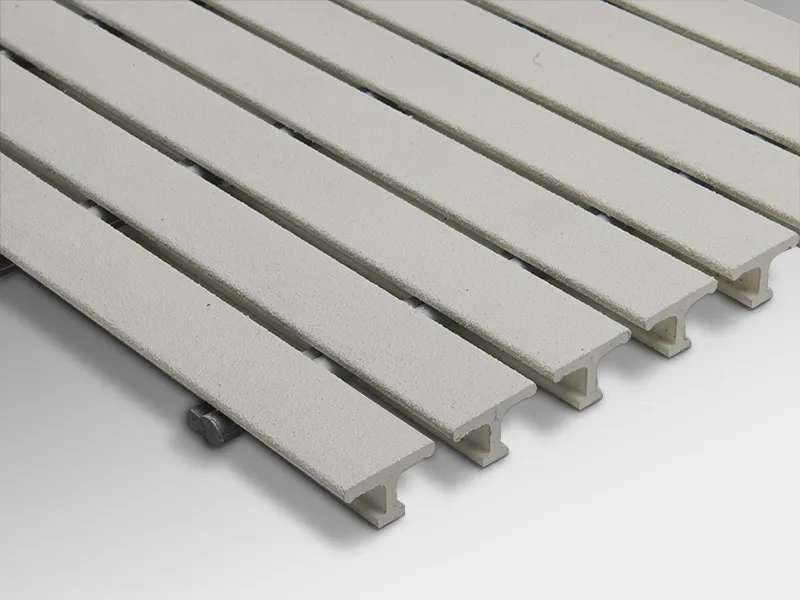
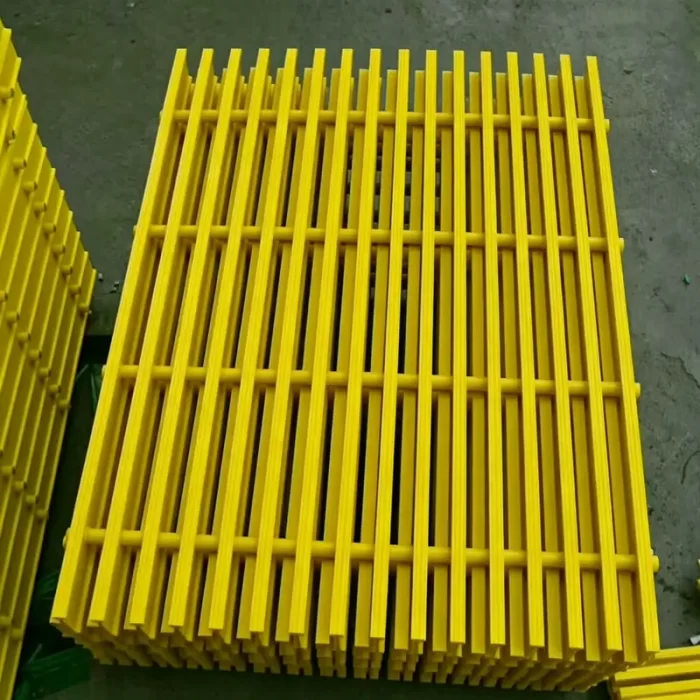
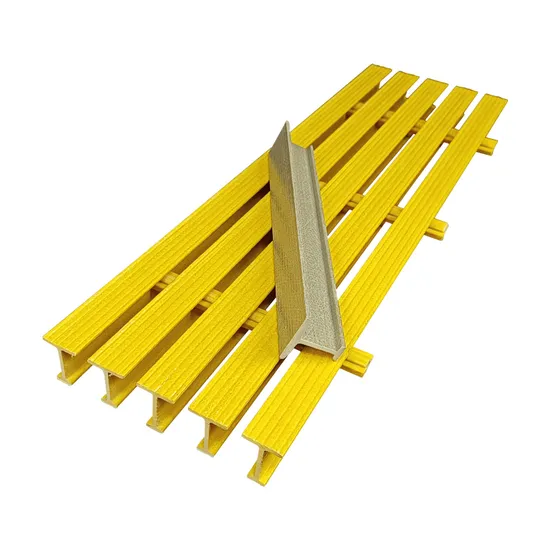
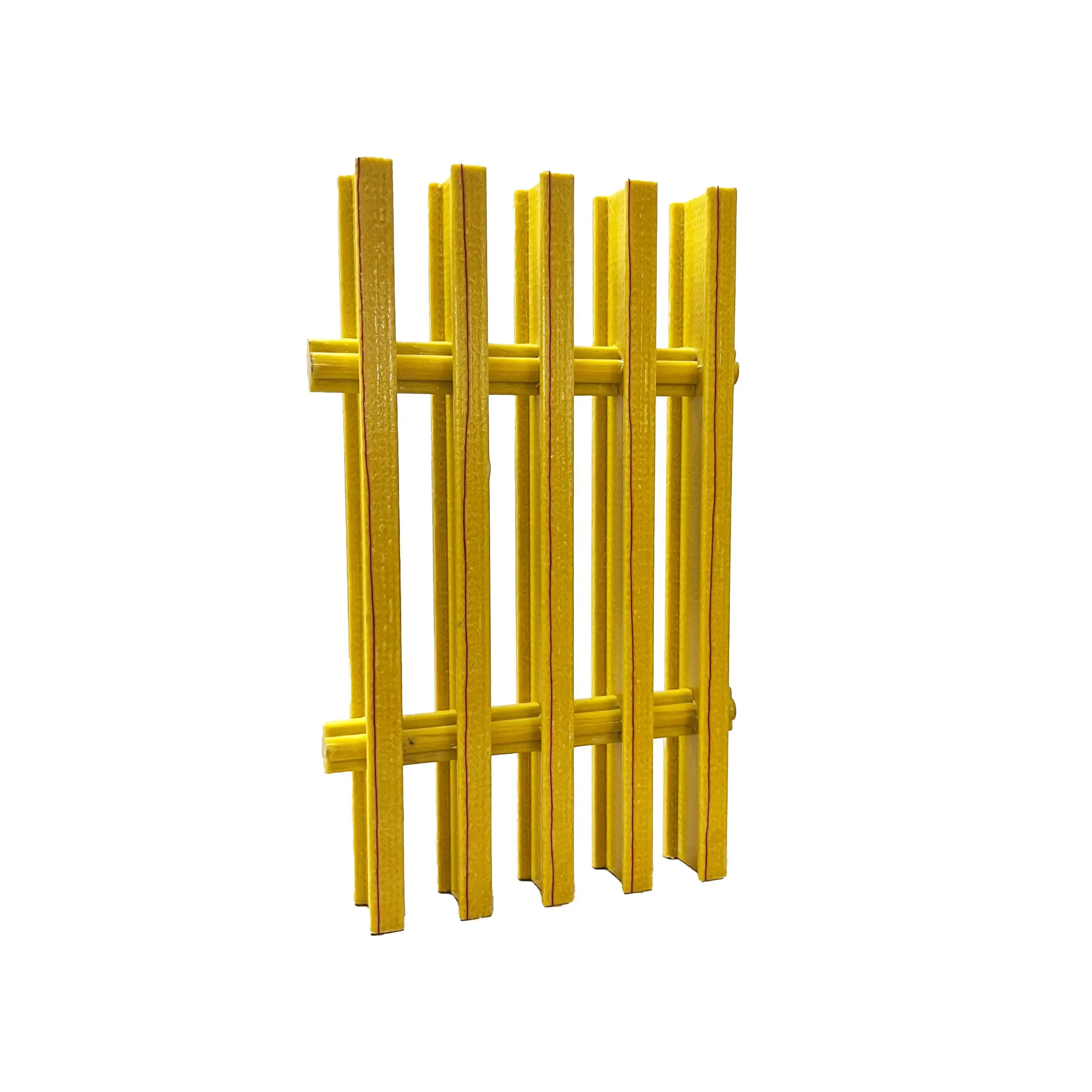
FRP pultruded grating is a high-strength, corrosion-resistant structural flooring system manufactured through the pultrusion process — a continuous molding method that produces parallel bearing bars with I-shaped or T-shaped profiles, mechanically assembled with perpendicular cross-rods to form rigid grating panels.
Unlike molded FRP grating — which is cast as a single panel with a square mesh pattern — pultruded grating features unidirectional glass fiber reinforcement aligned along the bearing bars. With a glass-to-resin ratio of approximately 70% glass to 30% resin, pultruded grating delivers roughly twice the stiffness of comparably sized molded grating and spans greater distances without intermediate support.
The pultrusion manufacturing method produces exceptionally consistent bar profiles with precise dimensional tolerances, making pultruded grating the preferred choice for heavy-load platforms, long-span walkways, vehicular access areas, and infrastructure projects where structural reliability is critical. Common applications range from chemical plant flooring and offshore platform decks to water treatment facilities and power generation stations.
FRP Pultruded Grating Manufacturing Process — How It's Made
At Dengtai's ISO 9001:2015 certified facility in Shijiazhuang, China, every pultruded grating panel follows a rigorous five-stage process. Understanding this process helps engineers and buyers appreciate why pultruded grating outperforms alternatives in demanding environments.
-
Step 1: Fiberglass Reinforcement Preparation
Continuous fiberglass roving (providing unidirectional strength along the bar length) and woven fiberglass mat (providing multidirectional reinforcement for transverse stability) are pulled from creels and fed through preforming guides. These precision guides begin shaping the raw glass fibers into the final bearing bar profile — either I-shaped or T-shaped — ensuring consistent fiber alignment that determines the bar's ultimate mechanical properties.
-
Step 2: Resin Impregnation (Wet-Out)
The precisely aligned fiberglass reinforcements are pulled through a thermoset resin bath — typically polyester, vinyl ester, or phenolic — blended with pigments for color, UV inhibitors for outdoor durability, mineral fillers for specific performance properties, and catalysts to initiate the curing reaction. The resin fully saturates every glass fiber, creating a monolithic composite where the resin transfers load between fibers and provides the final product's chemical resistance and environmental protection.
-
Step 3: Surface Veil Application
A lightweight polyester surface veil — essentially a thin, non-structural fabric — wraps completely around the wet-out reinforcement bundle just before it enters the heated forming die. This veil creates a resin-rich, smooth outer surface that significantly enhances chemical resistance by preventing corrosive media from reaching the glass fibers. It also improves UV resistance and provides a more aesthetically uniform appearance without adding measurable structural weight.
-
Step 4: Heated Die Curing & Precision Cutting
The fully impregnated and veiled material is pulled through a precision-engineered heated steel die at controlled speed and temperature. Inside the die, the thermosetting reaction occurs — the liquid resin crosslinks and hardens into a rigid, solid bearing bar with exact I-Bar or T-Bar geometry. The continuous bar exits the die fully cured and is cut to specified lengths by an automated saw with ±1.5mm accuracy. Die temperature, pull speed, and curing completeness are monitored in real time.
-
Step 5: Panel Assembly & Quality Inspection
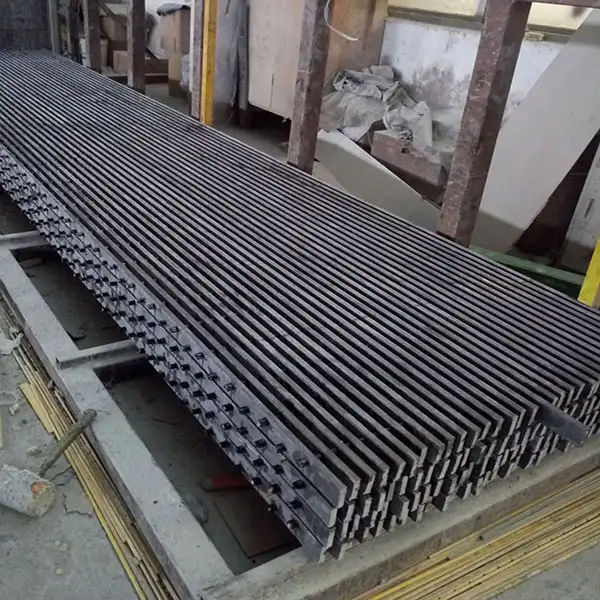
Precision holes are drilled at regular intervals along each bearing bar — typically every 2 inches or 4 inches center-to-center. Perpendicular cross-rods are inserted through these holes and permanently bonded with high-strength two-part epoxy adhesive. The fully assembled panel then undergoes a comprehensive QC protocol: dimensional verification against specification, visual inspection for surface defects, random sample flexural testing per ASTM D790, and full-panel load verification where specified. Only after passing all checks does the panel receive its anti-slip grit coating and final packaging.
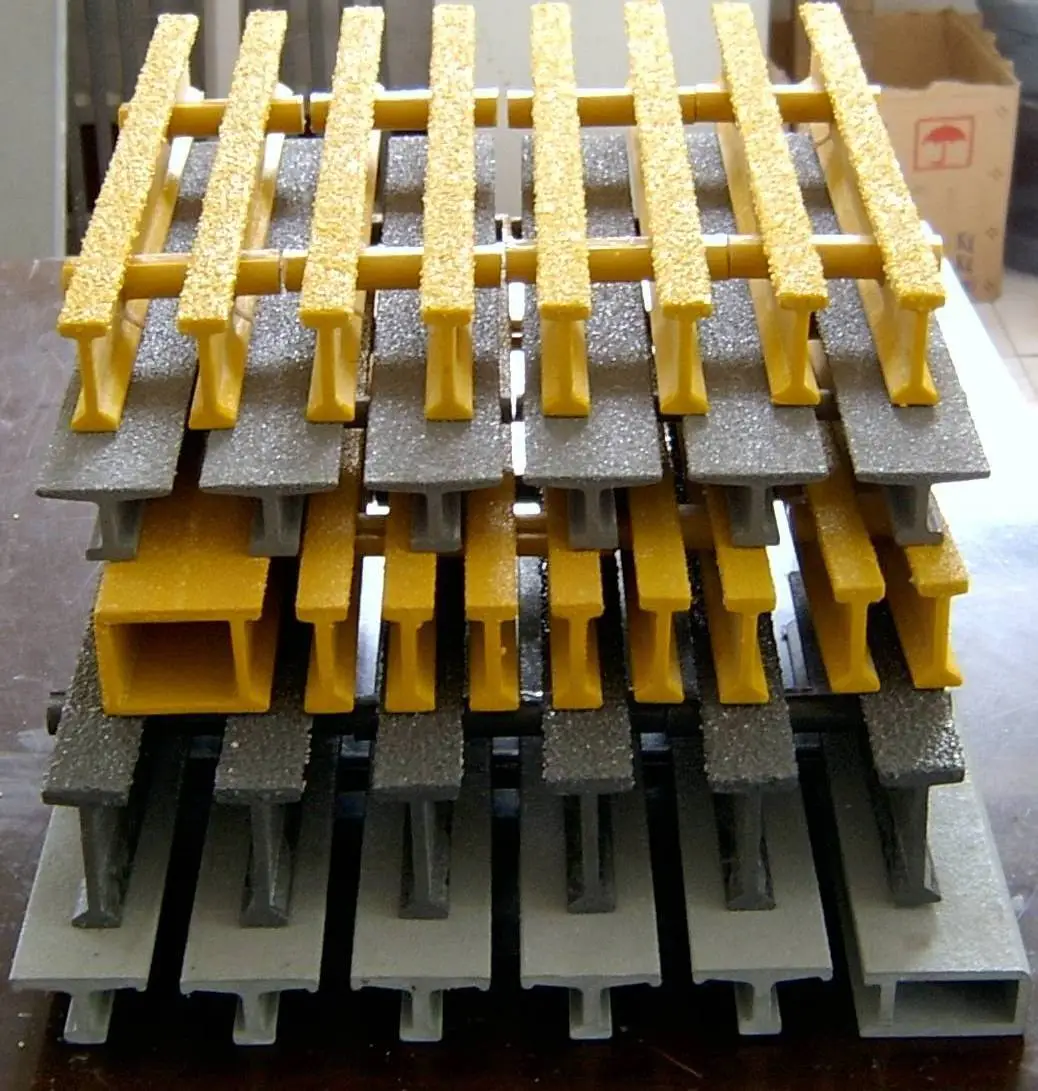
I-Bar vs T-Bar Pultruded Grating — Which Profile to Choose?
The choice between I-Bar and T-Bar bearing bar profiles fundamentally determines your grating's load capacity, span capability, weight, and cost. Making the wrong choice leads to either over-engineering (unnecessary cost) or under-engineering (safety risk). Here is a detailed technical comparison to guide your specification.
I-Bar Profile
I-shaped cross-section with flanges at top and bottom connected by a narrow vertical web. This geometry maximizes the section modulus — the measure of bending resistance — for a given amount of material, delivering the industry's highest stiffness-to-weight ratio.
- Depth 25 mm / 38 mm (1" / 1.5")
- Open Area 40% – 60%
- Max Span 4 ft (1.2 m) at 1.5" spacing
- Weight 2.4 – 4.4 psf per panel
- Best For Walkways, chemical plant flooring, light-duty platforms, cooling tower decks
T-Bar Profile
T-shaped cross-section with a wide top flange and vertical stem below. The flange provides maximum surface bearing area and exceptional resistance to bending under heavy concentrated loads. T-Bars use more material per linear foot than I-Bars, delivering superior absolute load capacity at the trade-off of higher weight and cost.
- Depth 50 mm (2")
- Open Area 33% – 50%
- Max Span 6 ft (1.8 m) at 2" spacing
- Weight 3.0 – 4.1 psf per panel
- Best For Heavy equipment access, offshore decks, vehicular traffic areas, helidecks
| Performance Factor | I-Bar | T-Bar |
|---|---|---|
| Stiffness-to-Weight | Highest | High |
| Absolute Load Capacity | 300 – 5,000 psf | 1,000 – 8,000 psf |
| Material Efficiency | Optimal — less material per unit of stiffness | Higher material use per panel |
| Panel Weight | Lighter — easier handling, lower freight | Heavier — more robust under impact |
| Corrosion Resistance | Identical — determined by resin system, not bar shape | |
Selection rule of thumb: Choose I-Bar for pedestrian walkways, light-duty platforms, and applications where weight savings and material efficiency matter most. Choose T-Bar for heavy equipment access, vehicular traffic areas, offshore/marine environments, and anywhere concentrated wheel loads or point loads are expected. When in doubt, provide our engineering team with your load case and span requirements for a specific recommendation.
FRP Pultruded Grating Technical Specifications
| Parameter | Standard Value(s) | Notes & Selection Guidance |
|---|---|---|
| Bearing Bar Depth | 25 mm / 30 mm / 38 mm / 50 mm | Deeper bars = higher load capacity and longer spans. 25mm for light pedestrian; 50mm for heavy vehicle. |
| Load Capacity | 300 – 8,000 psf (1.5 – 40 kPa) | Uniform distributed load rating. For concentrated loads, contact engineering. |
| Open Area | 40% – 60% | Higher open area = better drainage/airflow. Lower = more surface support for small objects. |
| Resin Systems | Polyester / Vinyl Ester / FR / Phenolic | See resin selection guide below for chemical compatibility and temperature ratings. |
| Bar Spacing (Center) | 1.5" (38 mm) or 2" (50 mm) | Closer = higher load capacity and smaller object pass-through. Wider = more economical. |
| Cross Bar Spacing | 2" (50 mm) or 4" (100 mm) | Closer cross bars increase transverse stiffness and panel rigidity under uneven loads. |
| Standard Panel Size | 4 ft × 20 ft (1,220 mm × 6,100 mm) | Also available in 3 ft, 4 ft, and 5 ft widths. Custom lengths upon request. |
| Fire Rating (ASTM E84) | Class I ≤25 / Class II | Fire-retardant resin achieves Class I. Phenolic achieves ≤5 with low smoke index. |
| Surface Finish | Grit-top anti-slip (standard) / Smooth | Meets ANSI A1264.2 and OSHA slip-resistance requirements for workplace safety. |
| Profile Types | I-Bar / T-Bar / Rectangular Bar | Rectangular bar available for extreme heavy-duty applications up to 3" depth. |
Load & Span Performance Data
The following table provides general load-deflection guidance based on standard Dengtai pultruded grating configurations. These values are for preliminary design only. Final engineered solutions should account for your specific support conditions, concentrated loads, and applicable safety factors.
| Profile | Bar Depth | Bar Spacing | Span 2 ft | Span 3 ft | Span 4 ft | Span 5 ft | Max Span |
|---|---|---|---|---|---|---|---|
| I-Bar | 25 mm (1") | 1.5" (38 mm) | 5,000 psf | 2,800 psf | 1,200 psf | — | 4 ft |
| I-Bar | 38 mm (1.5") | 1.5" (38 mm) | 8,000 psf | 4,500 psf | 2,500 psf | 1,000 psf | 5 ft |
| T-Bar | 50 mm (2") | 2" (50 mm) | 8,000 psf | 5,500 psf | 3,500 psf | 2,200 psf | 6 ft |
Load values above represent approximate uniform distributed load capacity (psf) at L/180 deflection limit — the standard criterion for pedestrian comfort. For vehicular traffic, use L/240 or L/360 limits. All values assume simply supported conditions with adequate bearing length at each support. Contact Dengtai for custom load tables matching your exact project parameters.
Resin Systems for Pultruded FRP Grating — How to Choose
The resin system is the single most important specification decision you will make — it determines chemical resistance, fire performance, UV stability, maximum operating temperature, and ultimately, service life. Selecting the wrong resin is the most expensive mistake in FRP specification, potentially reducing a 30-year service life to under 5 years in aggressive environments.
Isophthalic Polyester (Type I)
Best value for moderate chemical exposure. General industrial flooring, water/wastewater treatment, food processing, commercial buildings, pedestrian bridges. Excellent balance of cost, performance, and availability.
Not recommended for: strong oxidizing acids (nitric, chromic), concentrated caustic solutions above 100°F, aromatic solvents (benzene, toluene).
Vinyl Ester (Type V)
Superior resistance to both acids and alkalis. Chemical plants, electroplating facilities, bleach/solvent storage, offshore platforms, chlorine processing. Withstands environments that destroy polyester in 6-12 months.
Cost premium: approximately 20-30% above isophthalic polyester. Worth every dollar in aggressive chemical environments.
Fire Retardant (FR)
Public access buildings, data centers, enclosed industrial structures, tunnels, subway stations, schools, hospitals. Where local building codes or insurance requirements mandate ASTM E84 Class I compliance with verified self-extinguishing behavior.
Contains halogenated additives for fire suppression. Not recommended for applications where combustion byproducts could contaminate sensitive processes.
Phenolic
Offshore oil & gas platforms (USCG Level 2, DNV Type Approval, ABS certified), marine vessels, military naval applications, subway/metro systems. Maximum fire safety for life-critical environments where evacuation is constrained.
Cost premium: approximately 50-70% above isophthalic polyester. Mandatory for USCG-regulated vessels and most offshore platform specifications.
| Resin | Corrosion | ASTM E84 | Temp | Cost Index | Best Applications |
|---|---|---|---|---|---|
| Isophthalic Polyester | Very Good | Class I ≤25 | 150°F | 1.0x (baseline) | General industrial, water treatment, commercial |
| Vinyl Ester | Excellent | Class I ≤25 | 200°F | 1.2–1.3x | Chemical plants, offshore, plating, bleach |
| Fire Retardant | Good | Class I ≤25, SE | 150°F | 1.1–1.2x | Public buildings, data centers, tunnels |
| Phenolic | Very Good | Class I ≤5, LS | 300°F | 1.5–1.7x | Offshore, marine, military, subways |
Key Benefits of FRP Pultruded Grating
Strength-to-Weight
Up to 300% stronger than molded grating in the load direction. Supports 300–8,000 psf while weighing 75% less than equivalent steel grating. Fewer support beams needed per installation.
Corrosion Proof
Engineered to resist 700+ chemicals including sulfuric, hydrochloric, and nitric acids, sodium hydroxide, chlorine, and organic solvents. Zero rust. Outlasts steel 5-10x in corrosive service.
Lighter Than Steel
At ¼ the weight of steel grating, pultruded FRP reduces freight costs, eliminates crane requirements for installation, and lowers structural steel support requirements — often by an entire beam size.
Fire Rated
ASTM E84 Class I (Flame Spread ≤25) with self-extinguishing properties. Phenolic achieves ≤5 with smoke index ≤45 — meeting the strictest marine and offshore fire codes including USCG and SOLAS.
Slip Resistant
Epoxy-bonded silica grit coating on both bearing bars and cross bars. Meets or exceeds OSHA 1910.22 and ANSI A1264.2 coefficient of friction requirements for wet, oily, and icy walking surfaces.
Non-Conductive
Dielectric strength tested per ASTM D149. Safe for electrical substations, transformer bunds, MRI suites, and telecom facilities. Zero electromagnetic interference — radio and wireless signals pass through unimpeded.
Industrial Applications of Pultruded Grating
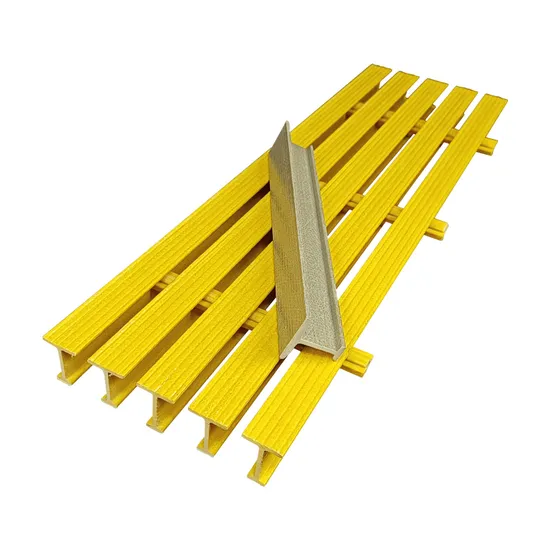
Chemical Processing
Walkways, platforms, trench covers in sulfuric acid, caustic soda, and solvent environments where steel fails in months. Read chemical plant guide →
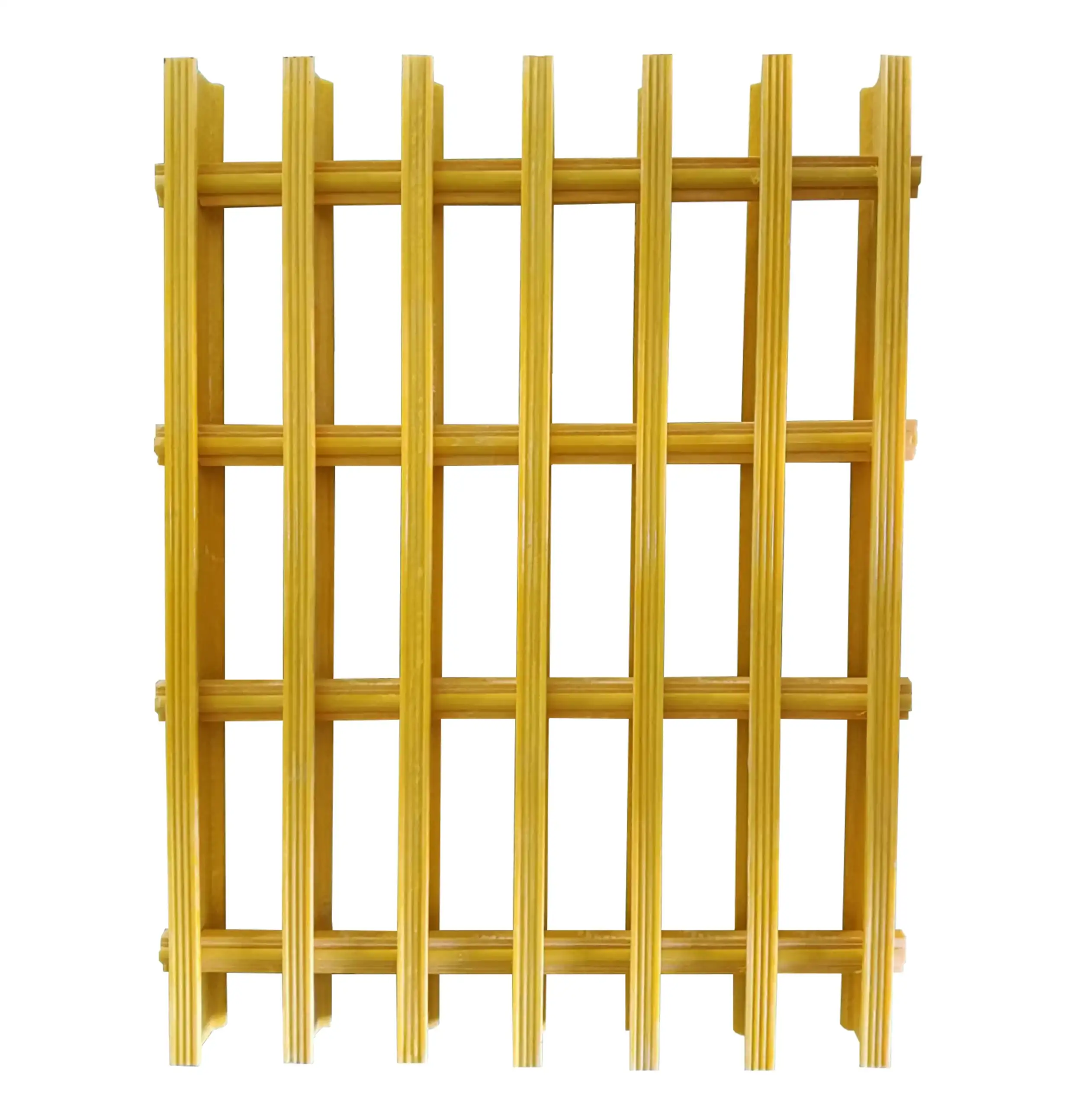
Offshore Oil & Gas
Deck grating, helideck walkways, pipe racks, and structural platforms in saltwater splash zones. Phenolic and vinyl ester for USCG/DNV/ABS compliance with documented fire performance.
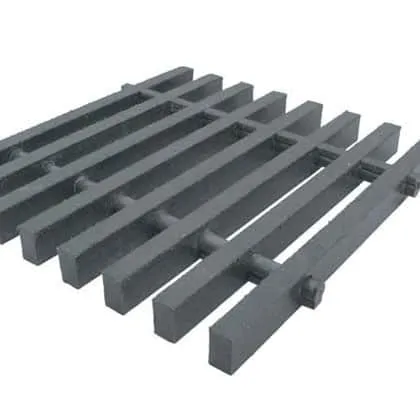
Water & Wastewater
Tank covers, aeration basin platforms, chemical dosing areas, digester covers. Superior resistance to chlorine, sodium hypochlorite, ferric chloride, and hydrogen sulfide atmospheres.
Power Generation
Non-conductive grating for transformer bunds, cable trenches, switchgear access platforms, and cooling tower decks. Zero EMI — safe for high-voltage environments up to 500kV.
Mining & Mineral Processing
Heavy-duty walkways and screen decks resistant to sulfuric acid leach solutions, abrasive slurries, and continuous heavy equipment traffic.
Food & Beverage Processing
Anti-slip washdown flooring, drainage covers, and platform grating. Non-porous surface prevents bacterial harborage; withstands CIP chemicals and steam sanitation.
Transportation Infrastructure
Pedestrian bridges, railway platform grating, boardwalks, ferry terminal decking. Light weight (75% less than steel) reduces dead load on existing structures and foundations.
Electroplating & Metal Finishing
Floor grating and tank surrounds in concentrated acid baths. Vinyl ester formulations withstand chronic exposure to chromic, sulfuric, and hydrochloric acid at elevated temperatures.
Marine & Shipbuilding
Deck grating, engine room platforms, ballast tank access. Phenolic with USCG Level 2 approval. Non-magnetic — critical for naval and research vessel applications near sensitive instruments.
Pharmaceutical & Clean Room
Non-shedding, chemically inert platform grating. Compatible with aggressive cleaning agents and sterilization protocols. Does not harbor microbial growth.
How to Select the Right Pultruded Grating — 5-Step Framework
Define Loads
Pedestrian: 100 psf min. Light vehicle: 2K–4K psf. Heavy equipment: 4K–8K psf. Include concentrated loads.
Calculate Span
I-Bar max 4 ft. T-Bar max 6 ft. Longer spans = deeper bars or more supports.
Identify Chemicals
List all chemicals, concentrations, and max temperatures. Match to resin compatibility data.
Check Fire Code
ASTM E84 Class I for buildings. Phenolic with USCG/DNV for offshore and marine.
Choose Surface
Grit-top anti-slip (standard, OSHA). 40% open for max load; 60% for max drainage.
Installation & On-Site Handling
One of pultruded grating's practical advantages is ease of installation. Unlike steel grating — which requires welding, torching, cranes, and specialized crews — FRP pultruded grating can be installed with standard tools and smaller teams. Here is what you need to know:
Cutting on Site
Use standard carbide-tipped or diamond-grit blades on circular saws, jigsaws, or angle grinders. No welding, no torching, no hot work permits needed. Always seal cut edges with catalyzed resin after cutting to maintain full corrosion resistance at exposed glass fibers.
Fastening Systems
Three standard 316 stainless steel clip types: Type M (hold-down between adjacent bars, no drilling), Type G (clamp to structural flange ≤3/4"), Type T (flange block for top-down cap screw installation). Select based on support structure and access direction.
Handling & Lifting
At 2.4–4.4 psf, standard 4'×20' panels weigh 192–352 lbs — manageable by 2-4 workers without mechanical lifting equipment. Compare to steel grating at 4x the weight requiring a crane or forklift for every panel placement.
Support Requirements
Pultruded grating is unidirectional — support is required only at the bearing bar ends, not on all four sides. This can reduce support steel costs by 30-50% compared to molded grating which requires perimeter support. Minimum bearing length: 1.5" (38mm) at each support.
Quality Standards & Certifications
ISO 9001:2015
Quality Management Systems — Dengtai fully certified since 2015. Every production batch traceable from raw material certificate of analysis through in-process QC, final inspection, and shipment documentation.
ASTM E84 / ASTM D635
Surface Burning (Class I ≤25 / Class II) and Rate of Burning (self-extinguishing verification). FR and phenolic formulations independently tested and certified by accredited laboratories.
EN 13706
Reinforced Plastic Composites — Pultruded Profiles (E23 grade). European standard governing dimensional tolerances, mechanical properties, and test methods. Required for EU-funded infrastructure and CE marking.
DNV / ABS Type Approval
Marine & Offshore Classification — phenolic grating certified for offshore platform and marine vessel structural applications. Compliance with IMO FTP Code and SOLAS fire safety requirements.
Custom Manufacturing & OEM Capabilities
As a factory-direct FRP grating manufacturer with over 18 years of experience, Dengtai offers comprehensive custom manufacturing and OEM services that most distributors simply cannot provide:
- Custom panel sizes — beyond standard 4'×20', we fabricate panels to your exact drawings with cut-outs, notches, and pipe penetrations. Reduces on-site cutting waste by up to 90%.
- Custom resin formulations — specific colors for safety coding (OSHA yellow, safety green) or corporate branding. Enhanced UV stabilizer packages for desert and tropical installations. Food-grade formulations for processing environments.
- OEM & private labeling — your company name and part numbers on grating panels, packaging, test reports, and shipping documentation. Full confidentiality and exclusivity agreements available.
- Non-standard bar configurations — custom bar depths (up to 3"), custom spacing, and rectangular bar profiles for extreme heavy-duty applications exceeding standard catalog specifications.
- Pre-assembly services — grating panels pre-cut, edge-sealed, and assembled into larger modules with pre-installed fasteners before shipping. Reduces on-site installation time by 60-80%.
- Complete system supply — one purchase order for grating + Type M/G/T stainless fasteners + matching FRP stair treads + handrail systems + adjustable pedestals. One supplier, one shipment, one set of documentation.
Frequently Asked Questions
Pultruded grating uses assembled I-Bar/T-Bar profiles with cross-rods — delivering unidirectional strength, 70% glass/30% resin ratio, and roughly twice the stiffness of molded. Molded grating is cast as a single panel with bidirectional strength and superior impact resistance but lower span capability. Choose pultruded for long spans and high loads; choose molded for chemical environments requiring maximum corrosion resistance and impact tolerance. Read full comparison →
Pedestrian walkways: 100 psf minimum (OSHA). Light maintenance vehicles: 2,000-4,000 psf. Forklift/HGV traffic: 4,000-8,000 psf with T-Bar profile. Always include concentrated load calculations for wheel loads — a 5,000 lb forklift on four small wheels creates far higher localized stress than a uniform load calculation suggests. Contact our engineers with your specific vehicle specs and traffic patterns.
25-30+ years in most industrial environments — 5-10 times longer than steel grating (3-5 years in corrosive service). Service life depends on chemical exposure type and concentration, UV exposure intensity, mechanical loading cycles, and ambient temperature. Phenolic grating in offshore service has documented cases exceeding 25 years with no structural degradation. All FRP grating requires zero painting, zero rust-proofing, and essentially zero maintenance beyond periodic washing.
Standard panel: 4 ft × 20 ft (1,220 mm × 6,100 mm). Also available in 3 ft, 4 ft, and 5 ft widths. Custom panel sizes, cut-to-length, cut-outs, notches, and pre-drilled mounting holes are available with typical lead times of 15-30 days depending on complexity and order volume. We recommend factory pre-fabrication for projects over 200 m² to minimize on-site labor and waste.
Yes. Use standard carbide-tipped or diamond-grit blades on circular saws, jigsaws, or angle grinders. No welding, torching, or hot work permits required. After cutting, seal exposed edges with catalyzed resin to restore full corrosion protection. For large-scale modifications, factory pre-fabrication is recommended to maintain quality control and reduce on-site labor costs.
Type M clips (316 SS) — secure panels between adjacent bearing bars, no drilling required. Type G clips (316 SS) — clamp to structural flange up to 3/4" thick. Type T flange blocks (316 SS) — allow top-down cap screw installation through grating surface. Adjustable pedestals — for elevated flooring systems requiring precise leveling. All available from Dengtai shipped with your grating order. We also supply matching FRP stair treads, handrail systems, and structural shapes for complete system procurement.
Standard MOQ: 100 m² for stock resin/color/profile configurations. Custom resins, non-standard colors, or specialized bar profiles may require 200-500 m² MOQ depending on production setup requirements. Dengtai can often combine multiple products (grating + stair treads + structural shapes) within one order to help you meet minimums. Contact our sales team with your full requirements for an exact quotation.
Yes to both. We provide free A4-sized sample panels (I-Bar and T-Bar profiles, your specified color and surface finish) for qualified project inquiries — you cover courier shipping. Sample lead time: 3-5 business days. Factory audits are welcomed and encouraged for orders over 500 m². We also offer live video tours via WeChat, WhatsApp, or Zoom if travel is not feasible. A legitimate manufacturer never refuses a factory visit request.
Need FRP Pultruded Grating for Your Project?
Get a factory-direct quote with custom specifications, load tables for your exact span and loading conditions, and competitive pricing from our ISO 9001:2015 certified manufacturing facility.
Serving 1,200+ clients across 50+ countries since 2005. Typical quote response: within 24 hours. Free samples available.